From a Shenzhen Kickstarter to $1.5B in revenue in three years — here's why Bambu Lab ate the 3D printing market and which model you should actually buy.
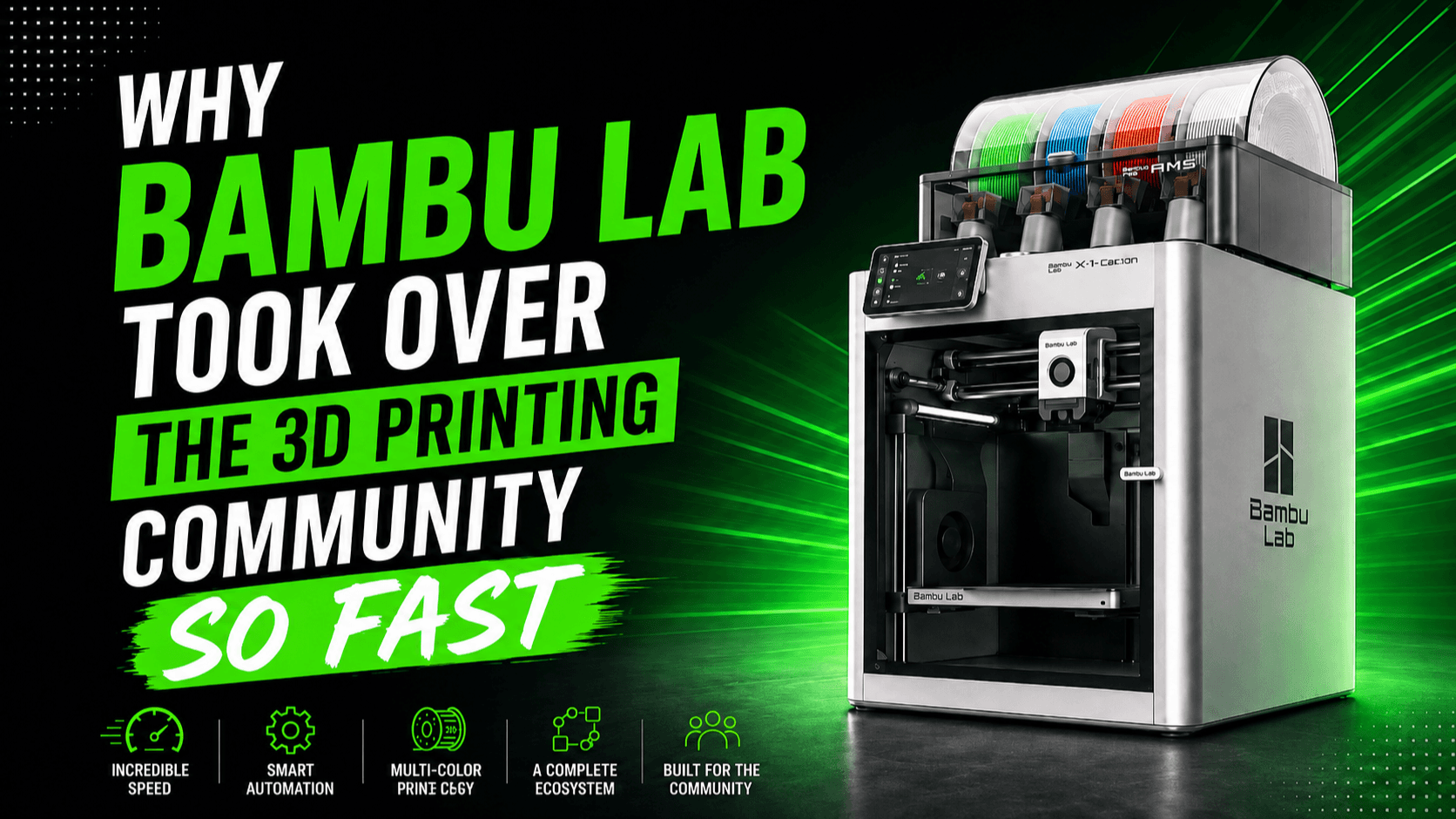
My Ender 3 needed eight hours of bed-leveling, belt-tensioning, and frantic Reddit scrolling before it produced a clean first layer. The A1 Mini I unboxed printed a perfect Benchy 14 minutes after I lifted it out of the box. That gap — between "3D printing is a hobby" and "3D printing is a tool" — is the whole reason Bambu Lab went from a stealth-mode Kickstarter pitch to over $1.5 billion in annual revenue in three years flat.
If you're trying to decide whether to drop money on one, or you just want to understand why every 3D printing subreddit now looks identical, here's what actually happened — and what it means for you.
For years, getting into 3D printing meant paying what makers called the Ender tax. You bought a cheap Creality Ender 3 for around $200 (roughly ₹17,000). Then you spent the next month dialing it in. Manual bed leveling. Belt tension. PID tuning. Klipper installs. OctoPrint setups. Stringing, warping, layer shifts. By the time the thing printed well, you'd dumped 40 hours into it and a couple hundred bucks of upgrades.
I loved that machine. I also wouldn't recommend you start there in 2026.
Here's what you do instead: buy a Bambu A1 Mini for $299 in the US (around ₹25,000 in India through authorized resellers), follow the four-step setup card, and you're printing in 20 minutes. The difference isn't small. Bambu didn't make a better Ender — they made a category that didn't exist. The "appliance" 3D printer. You don't tune it. You use it.
That single insight is what cracked the market open.
Bambu Lab's origin story sounds like a startup pitch deck because it basically was. In mid-2020, five engineers quit their jobs at DJI — the company behind the world's best-selling consumer drones — and crammed into an 80-square-metre office in Shenzhen. The founder, Dr. Ye Tao, was the former product manager for the DJI Mavic Pro. The whole team had spent years building consumer hardware that worked out of the box. That was the one thing 3D printing didn't have.
They worked in stealth for nearly two years. When they finally launched the X1 on Kickstarter in May 2022, the campaign pulled in over $7 million from more than 5,500 backers — one of the biggest hardware campaigns the 3D printing world had ever seen. Three years later, annual revenue had crossed $1.5 billion.
Compare a DJI Mavic to a 2015 hobby drone and you'll see the same UX leap Bambu later brought to printing. Auto-calibration. Integrated cameras. A product team that thinks in user flows instead of CAD files. That's the DNA they carried in. If you've ever flown a Mavic, you already know what a Bambu printer feels like — it's the same design instinct, just pointed at a different problem.
The first time you watch a Bambu print, you don't quite believe what you're seeing. The toolhead whips around the build plate at speeds that look wrong. The original X1 printed at 500 mm/s out of the box — nearly double the average for competing models in its price range, and in some cases five to ten times faster than the Ender-class machines most of us were running.
Four things made that possible:
You don't need to understand any of this to use the printer. That's the whole point. The hard engineering is hidden underneath a setup card that says press the screen, wait six minutes, print.
If the speed got people in the door, the AMS — Automatic Material System — is what kept them. It's a four-spool box that sits on top of the printer and feeds filament in based on what your file needs. Multi-color prints with no manual swap. Mixed materials in one job. Spool runs out mid-print, the next one feeds itself in.
I ran a 14-hour multi-color print on my P1S that had six color changes baked into the file. Zero attention from me. The AMS handled all of it while I slept.
Here's why that matters for you: every other consumer printer treats multi-material as a hack. You manually swap spools. You buy aftermarket MMU upgrades that fail more than they work. Bambu shipped multi-material as a default feature in the same box, calibrated, working. You plug it in once and forget it exists.
The combo bundles (printer + AMS) are where most buyers should land:
If you can stretch to the P1S Combo, do it. The enclosed chamber means you can run ABS, ASA, PA, and PC — the engineering-grade plastics open-frame printers can't touch without a custom enclosure you'll never get around to building. I know because I had three half-finished enclosures in my garage before I gave up and bought the enclosed printer.
Now the part of the story that doesn't show up in the marketing. Bambu is winning, but the way they're winning isn't entirely friendly to the open-source roots of 3D printing — and you should know what you're buying into before you commit.
The printers are tightly tied to Bambu's cloud and slicer. MakerWorld, their model platform, is excellent — and it's their walled garden. When a developer recently re-enabled features Bambu had disabled in firmware, the company threatened legal action. That's a long way from the Prusa-style "here's the source, mod it however you want" ethos that built this industry in the first place.
Four things to weigh before you buy:
None of this is a dealbreaker. Just go in with your eyes open. You're trading ecosystem freedom for time saved. For most buyers, that's a trade worth making — but it is a trade, and the people who pretend it isn't are the ones who haven't had to ship a replacement part on a deadline.
Here's the cheat sheet. Pick the smallest, cheapest model that fits what you actually print today — not what you might print three years from now:
You're a beginner, hobbyist, or buying for a student. Get the A1 Mini Combo. $449 in the US, around ₹38,000 in India. It's the most fool-proof entry point into 3D printing that has ever existed. PLA and PETG only, but those cover 80% of what you'll print in year one.
You want one printer that handles everything. Get the P1S Combo. Around $699 in the US, ~₹70,000 in India. Enclosed chamber, HEPA filter, every common filament including ABS and ASA, multi-color via AMS. This is the printer to buy if you're only buying one.
You're running a print farm or need flagship reliability. Get the X1 Carbon Combo while you still can — Bambu is winding it down in favor of the X2D. Around $1,299 in the US, ~₹1,65,000 in India. Lidar scanning, dual cameras, AI failure detection. Overkill for hobby use, mandatory for production.
You're in India specifically. Buy from an authorized reseller — Robocraze, KSP Electronics, Zbotic, or the official Bambu India channel. Don't import grey-market. Warranty becomes a nightmare and you'll pay 30–50% more once GST and customs hit anyway, with no support to show for it. The official Indian distributors price-match within a few percent of the dollar conversion once duty is factored in. The math works out.
Bambu Lab won because they understood something the rest of the industry kept missing: most people don't want to learn 3D printing. They want to print things. Creality, Prusa, Anycubic, and the rest were selling kits to hobbyists. Bambu sold finished products to everyone else — and the hobbyists came over anyway, because it turns out even hobbyists prefer things that just work.
The criticism about ecosystem lock-in is real and you should care about it. The convenience is also real, and most people will pick convenience every time. That's not a moral failing. That's how every consumer category eventually consolidates — phones, drones, e-bikes, now this.
Here's what you do: if you've been on the fence for six months waiting for the "right time" to buy a 3D printer, stop. Order an A1 Mini Combo this weekend. Print something useful in the first 48 hours — a cable organizer, a phone stand, a replacement knob for the appliance that's been broken for a year. That first useful print is the moment 3D printing stops being a "future hobby" and starts being a tool you actually own. Don't wait for the perfect machine. The one in your hands beats the one on your wishlist every time.