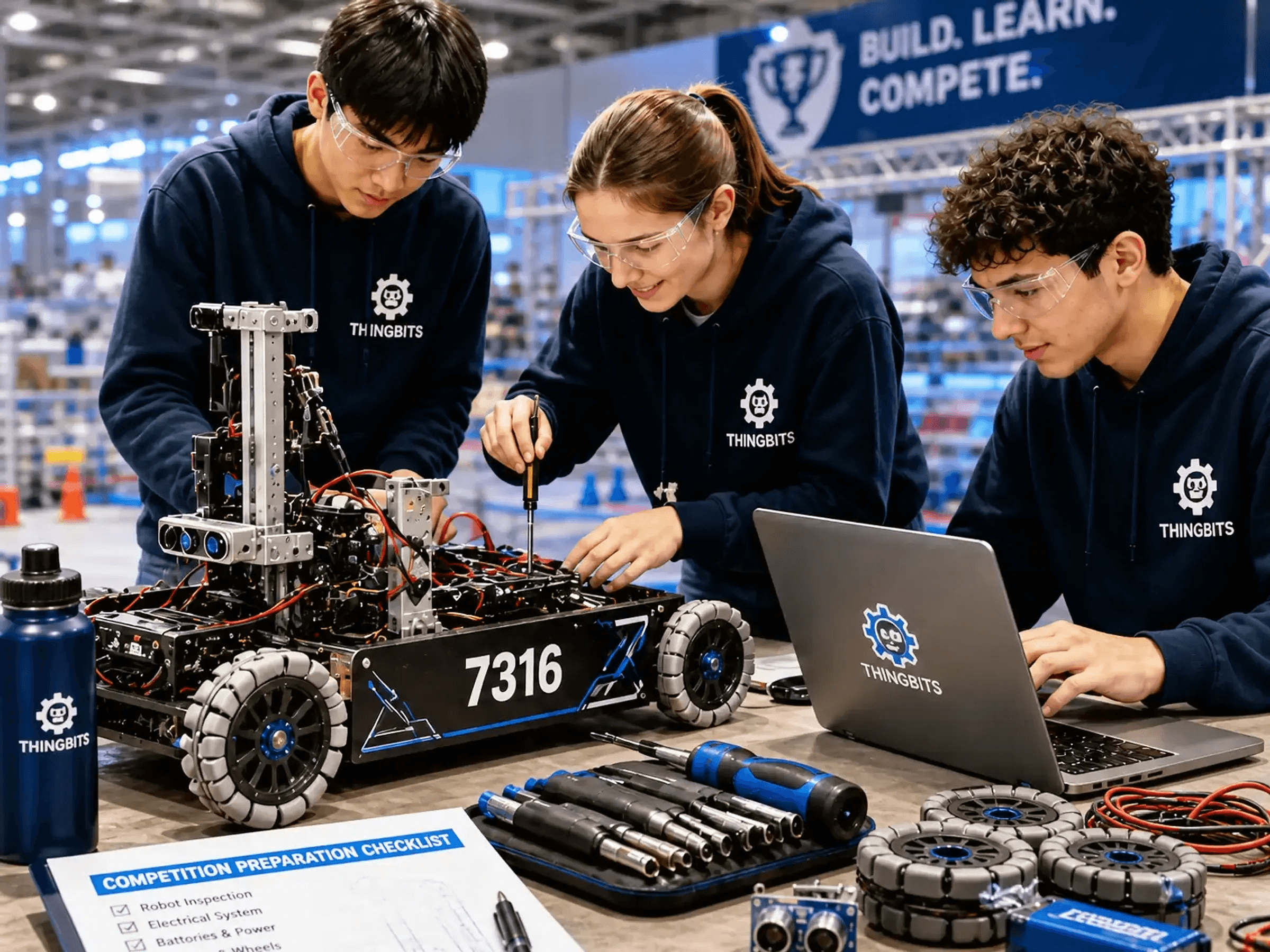
Robotics competitions are exciting, chaotic, and brutally honest. Your robot may work perfectly at home, then suddenly decide to become a decorative paperweight five minutes before the match. That is why preparation matters.
A good robotics team does not just build a robot. It builds a system: spare parts, tools, code backups, charging plans, testing routines, documentation, and calm heads under pressure.
This checklist will help students, hobbyists, and maker teams prepare for robotics competitions with fewer last-minute surprises and more confidence on the arena floor.
1. Understand the Competition Rules Clearly
Before building or packing anything, read the rulebook carefully. Not once. Several times.
Check these points first:
Robot size and weight limits
Allowed and banned materials
Battery voltage limits
Motor restrictions
Wireless communication rules
Arena dimensions
Scoring system
Safety requirements
Inspection requirements
Penalties and disqualification rules
Many teams lose points not because their robot is weak, but because they missed one small rule hiding in the rulebook like a tiny gremlin with a clipboard.
Create a one-page rule summary for your team. Keep it simple and visible during design, testing, and packing.
2. Define Your Match Strategy
A robot without a strategy is just a moving machine. Before finalizing the design, decide how your team wants to score points.
Ask:
What is the easiest reliable way to score?
What is the fastest way to score?
What tasks are risky but high-value?
What can our robot do consistently?
What should we avoid during the match?
Do not build every possible feature just because it looks impressive. A simple robot that performs one task reliably often beats a complex robot that performs five tasks badly.
For example, if the competition involves picking objects, pushing blocks, line following, or maze solving, focus first on the most repeatable scoring action. Build the fancy features only after the core function works smoothly.
3. Inspect the Mechanical Build
Mechanical problems are competition-day classics. Loose screws, slipping wheels, weak mounts, and wobbly arms can ruin a great design.
Before the event, check:
All screws, nuts, and bolts are tight
Wheels are firmly attached
Shafts rotate smoothly
Gears are aligned properly
Belts or pulleys have correct tension
Chassis is not bent or cracked
Motors are mounted securely
Arms, grippers, or mechanisms move freely
No wires are rubbing against moving parts
Robot fits within size limits
Use thread locker, lock nuts, or spring washers where vibration is likely. Robotics competitions are not gentle environments. Your robot will bump, shake, twist, and occasionally experience arena drama.
4. Check Motors, Drivers, and Power System
The power system is the heartbeat of the robot. If it fails, everything else becomes decoration.
Check the following:
Batteries are fully charged
Spare batteries are available
Battery connectors are tight
Motor driver current rating is suitable
Motors do not overheat during testing
Voltage regulators are working correctly
Main power switch is accessible
Fuse or protection circuit is installed if required
Battery is mounted securely
No exposed power wires are present
Run the robot for longer than a normal match. If your match is 3 minutes, test for at least 10 to 15 minutes. This helps reveal heating issues, battery sag, loose connectors, and motor driver stress.
5. Review Wiring and Connections
Bad wiring can turn a good robot into a mystery novel. One loose jumper wire can waste hours.
Before packing, inspect:
All wires are properly crimped or soldered
Connectors are firmly inserted
Signal wires are separated from high-current motor wires where possible
Wires are labelled
Cable ties or sleeves are used for neat routing
No wire is under mechanical stress
No copper is exposed
Polarity is clearly marked
Spare jumper wires and connectors are packed
For temporary breadboard circuits, be extra careful. Breadboards are useful for prototyping, but competition robots usually need stronger connections. Use screw terminals, soldered boards, JST connectors, Dupont housings, or custom PCBs wherever possible.
6. Test the Sensors Properly
Sensors often work beautifully in your workshop and behave strangely in the actual arena. Lighting, surface color, distance, and reflections can change everything.
Test sensors under different conditions:
Common sensors to verify:
Line sensors
Ultrasonic sensors
IR sensors
Encoders
IMU or gyro modules
Limit switches
Color sensors
Camera modules
Add calibration options in your code where possible. A small calibration routine before the match can save the robot from making philosophical decisions at the starting line.
7. Prepare and Back Up the Code
Your code should be competition-ready, not just “it worked once yesterday” ready.
Before the event:
Save the final working version clearly
Keep a backup on a laptop and cloud storage
Note the required libraries and versions
Remove unnecessary debug delays
Add useful serial/debug output if allowed
Comment important sections
Keep older stable versions available
Test upload process before leaving
Carry the correct programming cable
Carry any required USB drivers or board packages
Use clear file names such as:
robot_final_competition_v1
robot_safe_backup
robot_line_following_test
robot_manual_control_working
Avoid names like final_final_real_final_new2. That folder is where confusion goes to breed.
8. Create a Testing Routine
Random testing is better than no testing, but structured testing is far better.
Create a repeatable test routine:
Power on the robot
Check battery voltage
Test motor direction
Test steering or movement
Test each sensor
Test main scoring mechanism
Run one full match simulation
Inspect for loose parts
Check motor temperature
Recharge or swap battery
Record issues after each test. Even a simple notebook or spreadsheet helps. Write what failed, what was changed, and whether the fix worked.
This prevents the classic team argument: “Did we already fix that?” followed by everyone staring at the robot like it owes them money.
A well-packed tool kit can save your competition day. Do not assume the venue will have what you need.
Essential tools:
Useful extras:
Pack tools in a box with compartments. Competition pits can become tiny storms of wires, screws, and snacks. Organization helps.
10. Carry Spare Parts
Spare parts are not optional. They are your insurance policy.
Carry spares for:
Also carry spare mounting hardware. A working replacement motor is useless if you cannot mount it.
For small robots, it is often smart to carry one extra pre-tested electronics set: microcontroller, motor driver, power regulator, and receiver module if used.
11. Prepare the Laptop and Software
Your laptop is part of the robot system. Treat it that way.
Before the event:
Fully charge the laptop
Carry the charger
Install required IDEs
Install board drivers
Install libraries
Test code upload
Save offline copies of code
Save rulebook PDF offline
Disable unnecessary updates
Carry a USB hub if needed
Carry spare USB cables
Do not rely only on internet access at the venue. Event Wi-Fi can be slower than a sleepy servo.
12. Create a Pre-Match Checklist
Right before every match, use a short checklist. Keep it printed or written on a card.
Pre-match checklist:
Battery charged and connected
Power switch working
Robot starts correctly
Correct code uploaded
Wheels and motors checked
Sensors calibrated
Mechanisms reset to starting position
Loose parts checked
Robot within size limit
Team knows the match strategy
Keep this checklist short. The goal is speed and consistency, not a full engineering audit before every round.
13. Plan Team Roles
A robotics team works better when everyone knows their role.
Assign responsibilities such as:
Driver or operator
Programmer
Mechanical lead
Electronics lead
Pit manager
Strategy lead
Documentation lead
During the competition, avoid everyone working on the same problem at once. Three people holding one screwdriver is not teamwork. It is a tiny traffic jam.
Good teams communicate clearly, make quick decisions, and avoid panic-fixing things that are not broken.
14. Practice Under Competition Conditions
Practice should feel close to the real event.
Try to simulate:
Run multiple full matches. Time each run. Track scores. Observe failure points.
If your robot works only when one specific person gently places it at one specific angle on one specific table, it is not ready yet. Competition robots need tolerance.
15. Prepare Documentation
Some competitions require documentation, design reports, presentations, or inspection sheets. Even if they do not, documentation helps your team.
Prepare:
Robot specifications
Wiring diagram
Block diagram
Code flow overview
Component list
Battery details
Safety notes
Design explanation
Strategy summary
Good documentation also helps judges understand your work. A neat wiring diagram can speak louder than a nervous explanation given while your robot blinks mysteriously in the background.
16. Do a Final Packing Check
Before leaving for the competition, pack calmly and verify everything.
Final packing list:
Robot
Batteries
Battery charger
Laptop and charger
Programming cables
Tool kit
Spare parts
Extension board if allowed
Rulebook copy
Team ID cards or registration documents
Notebook and pen
Safety glasses if required
Tape and labels
Water and snacks
Use a box or bag dedicated only to the robot. Do not mix parts with personal items. A missing cable should not be hiding under a packet of chips.
17. Competition Day Mindset
Things may go wrong. That is normal. The best teams are not the ones that never face problems. They are the ones that recover quickly.
On competition day:
Stay calm
Read announcements carefully
Attend briefings
Respect volunteers and judges
Watch other matches
Learn from failures
Keep the pit area clean
Avoid last-minute unnecessary changes
Test after every repair
Celebrate small wins
Do not rewrite your entire code ten minutes before a match unless absolutely necessary. Competition day is for controlled fixes, not wild software archaeology.
Quick Robotics Competition Checklist
Use this shorter version as a final review.
Robot
Electronics
Code
Final version saved
Backup available
Libraries installed
Upload tested
Programming cable packed
Team
Final Thoughts
Robotics competitions reward preparation as much as creativity. A clever design is important, but a reliable robot, organized tool kit, tested code, and calm team can make the difference between “almost worked” and “match-winning run.”
Prepare early. Test honestly. Pack carefully. Keep backups. And when something fails, treat it as part of the game, not the end of the story.
Every competition makes your next robot better.