Arduino remains one of the best ways to start learning electronics because it combines simple hardware, beginner-friendly software, thousands of tutorials, and a huge component ecosystem. Here’s why it still deserves a place on every maker’s first workbench.
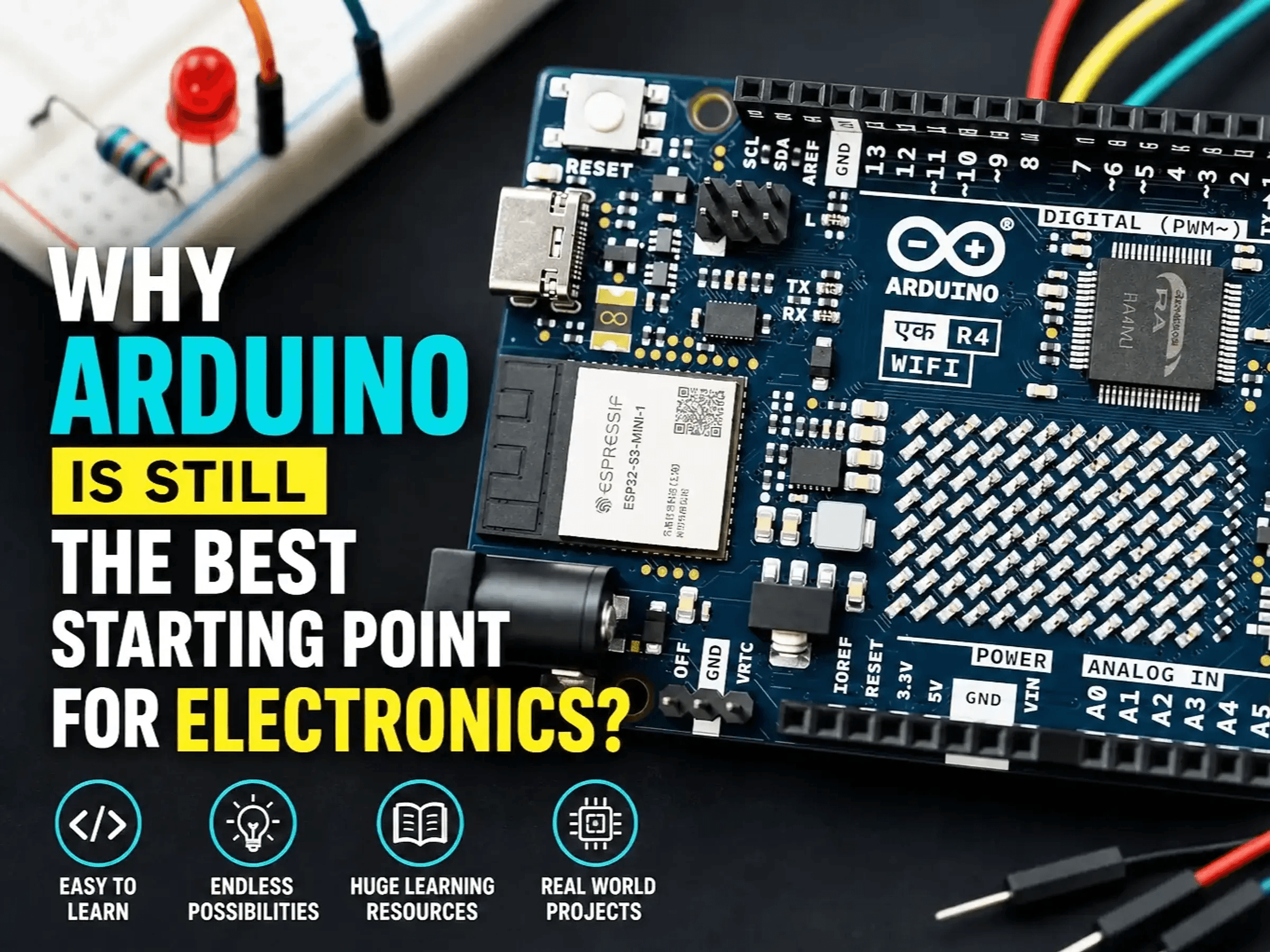
Electronics can feel intimidating at first. Wires, resistors, breadboards, sensors, code, power ratings, and the occasional mystery smell that was definitely not part of the plan. For a beginner, the hardest part is not building a complicated robot or smart device. The hardest part is simply finding a first step that does not feel like walking into a jungle with a teaspoon.
That is where Arduino still shines.
Even after years of new boards, faster chips, Wi-Fi modules, AI development kits, and tiny computers, Arduino remains one of the best starting points for learning electronics. Not because it is the most powerful board. Not because it is the newest. But because it gives beginners the one thing they need most: a smooth path from idea to working project.
When beginners start electronics, they are usually learning two things at once: how circuits work and how code controls hardware. That combination can become overwhelming very quickly.
Arduino reduces the friction.
You connect a board to your computer, open the Arduino IDE, write a small program, upload it, and see something happen in the real world. An LED blinks. A buzzer beeps. A motor turns. A sensor reacts to light or touch. Suddenly, code is not just text on a screen. It has escaped the computer and started poking the physical universe.
That moment is powerful.
For many beginners, the first blinking LED is the tiny lighthouse that says, “Yes, you can build things.”
Arduino does not force beginners to understand every deep technical detail on day one. You do not need to start with microcontroller registers, timers, datasheets, or complex build tools. Those things can come later.
Instead, Arduino lets you begin with simple concepts:
Digital output: turn an LED on or off
Digital input: read a button
Analog input: read a sensor value
PWM output: control brightness or motor speed
Serial monitor: print values and debug your project
This matters because beginners need early wins. A first project should not feel like assembling a submarine inside a thunderstorm. Arduino keeps the first steps small, visible, and satisfying.
One of Arduino’s biggest strengths is not just the board. It is the ecosystem around the board.
Need to control a servo motor? There is a tutorial.
Need to read a temperature sensor? There is probably a library.
Need to use an ultrasonic sensor, OLED display, relay module, joystick, RFID reader, or motor driver? The Arduino world has already left a breadcrumb trail.
For beginners, this is gold. You do not have to write everything from scratch. You can use existing examples, modify them, break them, fix them, and slowly understand what each line does.
That is how real learning happens: not by memorising syntax, but by tinkering with something that almost works.
Arduino boards are especially beginner-friendly because they pair well with the components most learners use first:
LEDs
Push buttons
Buzzers
Potentiometers
LDR light sensors
Ultrasonic sensors
Servo motors
DC motors
Relay modules
OLED and LCD displays
Basic wireless modules
This makes Arduino ideal for starter projects like traffic lights, automatic night lamps, mini weather stations, obstacle detectors, line-following robots, plant watering systems, and smart dustbins.
In other words, Arduino does not trap beginners in theory. It quickly moves them into small, buildable projects.
Arduino is still widely used in classrooms, hobby labs, and robotics clubs because it balances simplicity with flexibility. Students can start with basic circuits and gradually build toward bigger systems involving motors, sensors, displays, and communication modules.
For robotics competitions, Arduino is especially useful because students can test ideas quickly. Need to read a sensor? Try it. Need to control a motor? Wire it. Need to adjust timing? Change the code and upload again.
That fast feedback loop is the secret sauce. It keeps students curious instead of stuck.
Some people ask, “Why start with Arduino when there are more advanced boards?”
The answer is simple: beginners do not need the most advanced board. They need the board that teaches the fundamentals clearly.
Arduino helps learners understand:
Inputs and outputs
Voltage and current basics
Sensor readings
Motor control
Timing and delays
Debugging through serial output
Libraries and code structure
How hardware and software work together
These skills transfer to other platforms later. Once someone understands Arduino, it becomes easier to move into ESP32, Raspberry Pi Pico, STM32, Raspberry Pi, robotics controllers, IoT platforms, and more advanced embedded systems.
Arduino is not the final destination. It is the friendly railway station where the journey begins.
Arduino may be beginner-friendly, but it is not only for beginners. Many makers and engineers still use Arduino-compatible boards for prototypes because they are quick, inexpensive, and well-supported.
When you want to test an idea quickly, Arduino is often faster than setting up a more complex development environment. That makes it useful for proof-of-concept builds, classroom demos, product mockups, art installations, automation projects, and sensor experiments.
So while Arduino is excellent for a first project, it does not disappear once you improve. It simply becomes one tool in a much larger maker toolbox.
Boards like ESP32, Raspberry Pi Pico, and Raspberry Pi are excellent, but they can introduce extra decisions early on.
ESP32 brings Wi-Fi and Bluetooth, but it can feel slightly more complex for absolute beginners. Raspberry Pi is powerful, but it is a small computer rather than a simple microcontroller board. Raspberry Pi Pico is affordable and capable, but Arduino still has a larger beginner-friendly tutorial culture around common starter projects.
Arduino wins the first-round fight because it keeps the beginner focused on the basics:
Connect component.
Write simple code.
Upload.
Observe result.
Repeat.
That loop is the heartbeat of learning electronics.
A beginner can start with simple projects and slowly add complexity. Good first Arduino projects include:
Blinking LED
Learn digital output and timing.
Button-Controlled LED
Learn digital input and basic interaction.
Brightness Control With Potentiometer
Learn analog input and PWM output.
Automatic Night Lamp
Use an LDR sensor to detect light levels.
Distance Measurement Using Ultrasonic Sensor
Learn sensor reading and serial output.
Servo Motor Control
Learn movement and angle control.
Mini Weather Station
Combine sensors with a display.
Line-Following Robot
Bring together sensors, motors, and logic.
Each project adds one new idea without turning the workbench into a spaghetti republic.
For most beginners, an Arduino Uno-style board is still the safest starting point. It has a simple layout, plenty of tutorials, standard pin spacing, and broad compatibility with shields and modules.
A good beginner kit should include:
Arduino Uno-compatible board
USB cable
Breadboard
Jumper wires
LEDs
Resistors
Push buttons
Potentiometer
Buzzer
Basic sensors
Servo motor
Display module if possible
With just these parts, a beginner can build dozens of projects and learn the foundations properly.
Arduino is still the best starting point for electronics because it respects the beginner’s journey. It does not demand perfection. It invites experimentation.
It lets you make mistakes, fix them, and learn from the tiny sparks of progress along the way. It turns abstract concepts into real-world actions. It makes electronics feel less like a locked laboratory and more like a desk-sized playground with wires.
New boards will keep arriving. Chips will get faster. Tools will become smarter. But for learning the core magic of electronics, Arduino still holds its place.
Because the best first board is not the one with the longest spec sheet.
It is the one that makes you build your next project.