At Thingbits, choosing products is not just about adding more items to a catalogue. It is about finding parts, tools, modules, and machines that makers can actually use with confidence. Here is how we decide what deserves a place on our shelves.
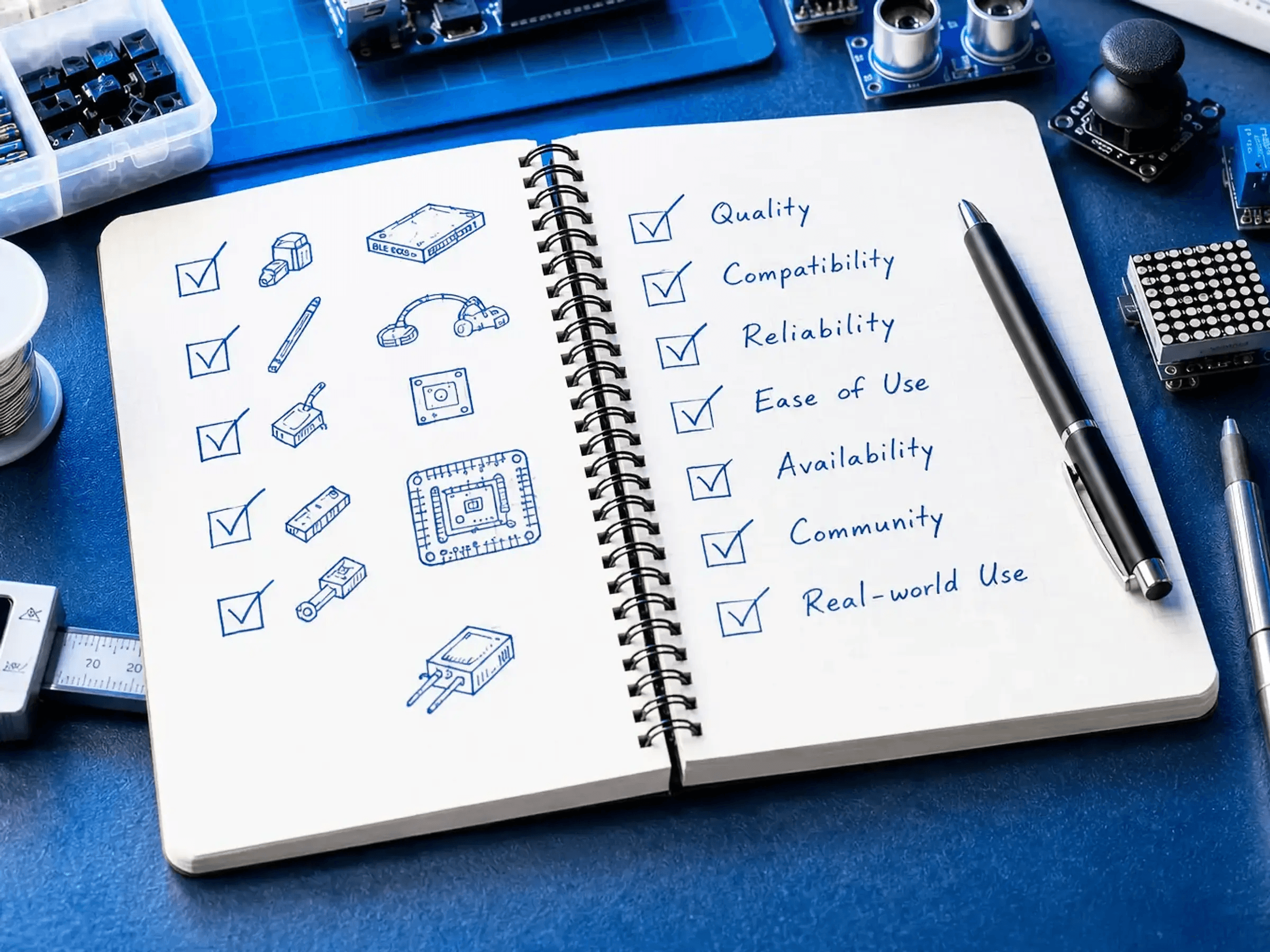
A maker’s bench has a strange kind of honesty.
A board either powers on, or it does not. A connector either fits, or it ruins your afternoon. A 3D printer either produces a clean part, or it teaches you new words in three languages. That is why product selection matters so much in the maker world.
At Thingbits, we do not want to be just another electronics catalogue with an endless jungle of parts. Our goal is to build a collection that helps makers, students, engineers, educators, startups, hobbyists, and repair tinkerers find products they can trust.
This is how we think about choosing products for makers.
Before adding a product, we ask a simple question:
What will someone build with this?
That question keeps us grounded. A product may look impressive on paper, but if it does not solve a real problem for a real project, it does not automatically belong in our catalogue.
We look for products that support common maker needs such as:
Prototyping electronics
Learning embedded systems
Building robotics projects
Creating IoT devices
3D printing functional parts
Repairing and modifying equipment
Teaching electronics in classrooms and labs
Moving from breadboard experiments to finished prototypes
For example, a development board is not just a development board. We think about whether it is good for beginners, whether documentation is available, whether it works with common software tools, and whether makers can realistically use it in Indian conditions.
A good product should not sit in a drawer like a mystery artifact. It should invite someone to build.
Popularity helps, but it is not enough.
Some products become famous because they are genuinely useful. Others become famous because the internet briefly pointed a giant flashlight at them. We try to separate the long-term tools from the short-lived sparkle.
When evaluating a product, we consider:
Is it useful across many projects?
Is it beginner-friendly or clearly meant for advanced users?
Does it have proper documentation or community support?
Are accessories, cables, spares, or compatible modules available?
Is it reliable enough for repeated use?
Does it offer good value for its price?
This is especially important for makers because many projects depend on combinations of products. A sensor needs a compatible microcontroller. A 3D printer needs filament, nozzles, build surfaces, and maintenance parts. A Raspberry Pi project may need a power supply, case, cooling, storage, display, and cables.
A product is only truly useful when it fits into a wider ecosystem.
Every maker knows the tiny frictions that slow down a project.
The missing jumper wire. The wrong connector. The underpowered adapter. The sensor that needs a library from a forgotten corner of the internet. The module that works only after reading seven forum posts and sacrificing one weekend.
We try to choose products that reduce these frustrations.
That means we pay attention to details such as:
Standard connectors
Clear pin labels
Good build quality
Stable power requirements
Commonly supported chipsets
Availability of examples or tutorials
Compatibility with popular platforms
Long-term usefulness beyond one project
This does not mean every product must be beginner-level. Advanced tools and components are important too. But even advanced products should be clear about what they are, who they are for, and what a maker needs to use them properly.
Good products respect your time.
Makers are wonderfully unforgiving in the best possible way.
They notice loose connectors. They notice bad solder joints. They notice inaccurate listings, confusing specifications, weak packaging, and products that look similar but behave very differently.
So when we consider a product, we look beyond the title and the thumbnail. We care about whether it can survive actual use on a workbench, in a lab, in a classroom, or inside a prototype that keeps being opened, closed, rewired, and tested.
Quality does not always mean expensive. It means the product should honestly deliver what it claims.
For some categories, that may mean branded products from trusted manufacturers. For others, it may mean carefully selected compatible modules that offer good performance at a fair price. The point is not to chase the highest price tag. The point is to avoid products that waste a maker’s time.
A cheap product is not cheap if it breaks the project.
A maker rarely buys only one item.
Someone buying an Arduino-compatible board may also need jumper wires, a breadboard, resistors, LEDs, sensors, a USB cable, and a power source. Someone buying a 3D printer may later need filament, spare nozzles, build plates, cleaning tools, and replacement parts.
That is why we look at product selection as an ecosystem, not a shelf-by-shelf exercise.
When we add products, we ask:
What will this product be used with?
What accessories should be available alongside it?
What spares might the customer need later?
Can this product become part of a learning path or project path?
Does it fit with other products makers already trust?
This helps us build a catalogue that feels connected. Not random boxes floating in space, but a workshop where things naturally belong together.
Some of the best product ideas come from people already building things.
Customers ask for parts they need for repairs. Students look for affordable components for projects. Educators need products that are reliable enough for batches of learners. Startups need modules and tools that help them prototype quickly.
These conversations shape what we add next.
We pay attention to repeated requests, project trends, support questions, and gaps in availability. If many makers are asking for the same type of product, that tells us something. If customers struggle with a product category because the choices are confusing, that also tells us something.
A good catalogue is not built by guessing alone. It is built by listening.
Thingbits serves a wide range of makers.
Some are buying their first breadboard. Some are building school projects. Some are creating IoT devices. Some are running print farms. Some are prototyping products for a startup. Some simply enjoy the noble chaos of taking things apart and making them better.
So our product selection has to support different stages of the maker journey.
We look for:
Entry-level products that help beginners start safely
Reliable everyday components for regular prototyping
Upgrade products for makers who are ready to go deeper
Professional tools for serious workbenches
Spares and consumables that keep projects running
The aim is to help someone grow. A beginner today may become an advanced builder tomorrow. The products they find at Thingbits should support that journey without forcing them to start from scratch every time.
More products do not always mean a better experience.
A catalogue with ten confusing versions of the same module can make buying harder, not easier. Makers should not need to solve a puzzle just to choose a basic component.
We would rather build a thoughtful selection than flood the store with every possible variant. When multiple options are useful, we try to make the difference clear. When one option is better for most people, we prefer not to hide it inside a maze.
The goal is simple: make it easier to choose the right thing.
A maker’s energy should go into building the project, not decoding the catalogue.
A product does not stop mattering after it is shipped.
Can we help the customer use it? Can we support common questions? Are replacement parts available? Is the product too fragile for normal shipping? Does it need special handling? Will customers need guidance before buying it?
These questions matter because the maker experience includes everything after checkout too.
For technical products, support is part of the product. If something requires careful setup, specific accessories, or compatibility checks, we want to understand that before adding it. This helps us avoid unnecessary frustration for customers and support teams alike.
A product that is difficult to support may still be worth carrying, but only when we can be clear about what buyers should expect.
The right product can do more than complete a project. It can teach.
A well-labeled sensor module can help someone understand pinouts. A reliable multimeter can make debugging less intimidating. A good 3D printer can turn design ideas into physical parts. A proper power supply can prevent a beginner from accidentally entering the smoke dimension.
That is why choosing products for makers is also about choosing learning experiences.
We want products that help people gain confidence, not just consume hardware. The best maker products encourage experimentation. They make people curious. They make the next project feel possible.
At Thingbits, we choose products with a few core beliefs:
Useful beats flashy.
A product should help someone build, learn, repair, test, or create.
Reliable beats random.
Makers need parts they can trust, especially when projects depend on them.
Clarity beats clutter.
A good catalogue should make choosing easier, not harder.
Ecosystems beat isolated products.
Boards, modules, tools, spares, and accessories should work together.
Support matters.
Technical products need honest information and practical guidance.
Makers grow.
The catalogue should support beginners, hobbyists, educators, professionals, and everyone moving between those stages.
Choosing products for makers is not just procurement. It is curation with a soldering iron nearby.
Every product we add has the potential to become part of someone’s first robot, first prototype, first classroom demo, first repair, first startup experiment, or first late-night breakthrough.
That matters to us.
At Thingbits, we are building a catalogue for people who build things. That means choosing products with care, testing assumptions, listening to customers, and constantly improving the selection as the maker community grows.
Because behind every component is a project. Behind every project is a person trying to make an idea real.
And that is exactly the kind of thing we want to support.